 |
| last year, there's no way Aiden could've worn flip flops, much less dodge his sister's water gun aim; here, he's running in flip flops while yelling, "STOP IT KAILYN", and proceeds to jump over the hose to reclaim his water gun. |
- PHONEMIC MAPPING - read more HERE, and HERE
- PRAXIS/MOTOR PLANNING/SENSORY PROCESSING challenges that were affecting his spontaneous expressive language (among other things). I write about this HERE and pretty much sum it all up HERE.
Although his mappings weren't completely off, the phonemic mappings definitely helped us know he's hearing all sounds and we went from a good map to a great map - big difference. The identification of his praxis challenges made me call and get on a waiting list at a specialized OT clinic before even leaving California.
Praxis? Motor planning? sensory processing disorder? I still get confused about them all, how they're related and how they're different. They can go hand in hand or not. Aiden has never been officially diagnosed with any certain medical term, but definitely has "tendencies" and challenges of them. So here's my best stab at explaining it (and I am in no way a professional OT, this is just from all my reading and notes taken at Aiden's OT):
What is praxis?
The ability to quickly and efficiently take in sensory information, process it, and respond. It includes, IDEATION (planning the idea in the mind); MOTOR PLANNING (making a plan for the action), and EXECUTION (doing the activity). Different praxis challenges can include apraxia/dyspraxia (both deal with difficulty in motor planning); ataxia (loss of coordination of the muscles); and more. Any of these can be mild to severe.
What is sensory processing disorder (spd)
Sensory processing (or integration) is how our nervous system receives messages from the senses and turns them into appropriate motor and behavioral responses. SPD is when these messages do not get organized into appropriate responses, which creates challenges in performing everyday tasks (including speaking and balance). Children with SPD often have difficulty with varying motor skills and other everyday skills which can lead to social isolation.
NOTE - there are SEVEN senses that can be affected - not just vision, auditory, taste, tactile, and olfactory, BUT also, the sense of movement (vestibular system) and the positional sense (proprioception). Aiden has definite disconnects in his vestibular and proprioceptive world, along with challenges having all his senses work as one as they should. And when any of these senses aren't "working together as a team", the child (and the world around him) seems out of sync.
A. Jean Ayres, Ph.D., said it best in her book, Sensory Integration and the Child,
"Good sensory processing enables all the impulses to flow freely and reach their destination quickly. Sensory integrative dysfunction is sort of a 'traffic jam' in the brain. Some bits of sensory information get 'tied up in traffic' and certain parts of the brain do not get the sensory information they need to do their jobs." (Ayres, p. 51)
So how has all this affected Aiden and what has OT done to help?
First, it was clear our lil' dude's environment was out of sync - both in motor planning, execution, and sensory. For example:
- On off balance days his speech was greatly diminished.
- Some days Aiden would say clear 4-5 word sentences (mainly those that were repetitive to him like, "I want milk please"), others his speech was very jumbled unless speaking in one to two word sentences, and sometimes we couldn't understand him at all.
- Speech involves motor planning of many different muscles and breath control - Aiden had (and still has) difficulty coordinating these two to work together - especially with multi-syllabic words and sentences longer than 3-4 words.
- Aiden was the kid who played alone, at a table doing puzzles or building with blocks (something stationary and away from the crowd), while all the other kids were running around dressing up, pushing trucks along the floor, etc. It was almost as if it was "too much" for him to handle - visually, gross motor, noise, proprioceptive, and balance wise ... I'd watch this from the two way mirror at JTC ... and it broke my heart.
- Aiden had difficulty performing two different sensory tasks, for example, walking across a set of six balance buckets while talking or following a simple direction, standing still on a simple piece of material to catch a ball, balancing himself while sitting on a peanut ball or moving swing while throwing a ball or picking something up.
- It takes a lot of input for things to register - his muscles need extra input to know where they're at, to know what to do to execute. Aiden does not talk if his actions are too sedentary, it's almost as if he needs to move - to run, to push/pull heavy things, to jump, to swing - to get all the wheels in his brain to work together to produce speech and much more. At his old school, he was having more off balance days than usual, he was not speaking that much, and I attribute this to the classroom way of more "sitting and doing", rather than "moving and doing".
- He wasn't crossing mid-line (reaching across the body with either arms or legs), which is a very important prerequisite for appropriate development of various motor and cognitive skills. He still doesn't have a hand preference, which is not uncommon though with kids with sensory issues.
I can't speak enough of how much Aiden has grown from this therapy. Nine months ago, I walked into our first OT session with Miss Amie. That same day I knew we found our miracle worker and ever since she has been magic. She works with Aiden and doesn't let him stop, doesn't let him fail. She works his sensory systems to train them to work together - heavy lifting or spinning to get his motors moving; obstacle courses that involve a combination of climbing, jumping, visual tracking, listening to directions, balancing, swinging, etc. ALL THE WHILE PROVIDING AUDITORY INPUT and demanding verbal responses from Aiden. She makes him speak and does not go on until she gets a clear answer while he's performing some other demanding task.
And here's what we have received:
And here's what we have received:
- 9 MTHS AGO: Aiden was rarely crossing mid-line; TODAY: No problems
- 9 MTHS AGO: 2-3 words per sentence, speech was slurred/choppy; TODAY: 5-7 (sometimes more) words per sentence, words definitely more crisp and understandable (although he still can have his off days).
- 9 MTHS AGO: Aiden couldn't stand on one balance bucket without holding onto someone's finger; TODAY: he can walk across six without falling off AND even stop, keep his balance, bend over to pick up a toy on the floor (after listening to a verbal direction), stand back up, and keep on going!
- 9 MTHS AGO: Aiden did not like moving objects - such as the swing at the park; TODAY: He not only loves to swing, but he is balancing himself on a moving object, while visually tracking Amie's hand, to grab "whatever it is" she is holding, then throwing it into a basket in a completely different location. THIS.IS.HUGE.
- 9 MTHS AGO: Aiden could barely walk up the curb without holding onto my hand and he definitely wouldn't walk down our two front steps alone. TODAY: Aiden is jumping two feet from the top step over the bottom step and landing without falling.
- 9 MTHS AGO: When Aiden tried to jump, his feet really didn't leave the ground. TODAY: He HOPS and GALLOPS and JUMPS in nearly every step he takes.
- 9 MTHS AGO: Aiden rarely initiated peer play, rarely talked to peers, and my heart broke that he may be the loner child; TODAY: Aiden is the one approaching kids at the park and yelling, "HEY BOY! C'MON LET'S PLAY!"
I even see a difference in his pain tolerance. While he still has a high one, I definitely see that pain registers quicker than it used to. Aiden is still uneasy on bumpy surfaces and can still have off balance days. He has EVA and I believe that his off-balance days are going to be something he'll learn to compensate for.
We still have a ways to go, and not sure when the end to OT will be, but with our "amazing Miss Amie", along with our other recent changes (school and therapy), we've found our Yellow Brick Road!
We still have a ways to go, and not sure when the end to OT will be, but with our "amazing Miss Amie", along with our other recent changes (school and therapy), we've found our Yellow Brick Road!
and that alone right there, gives me tears.


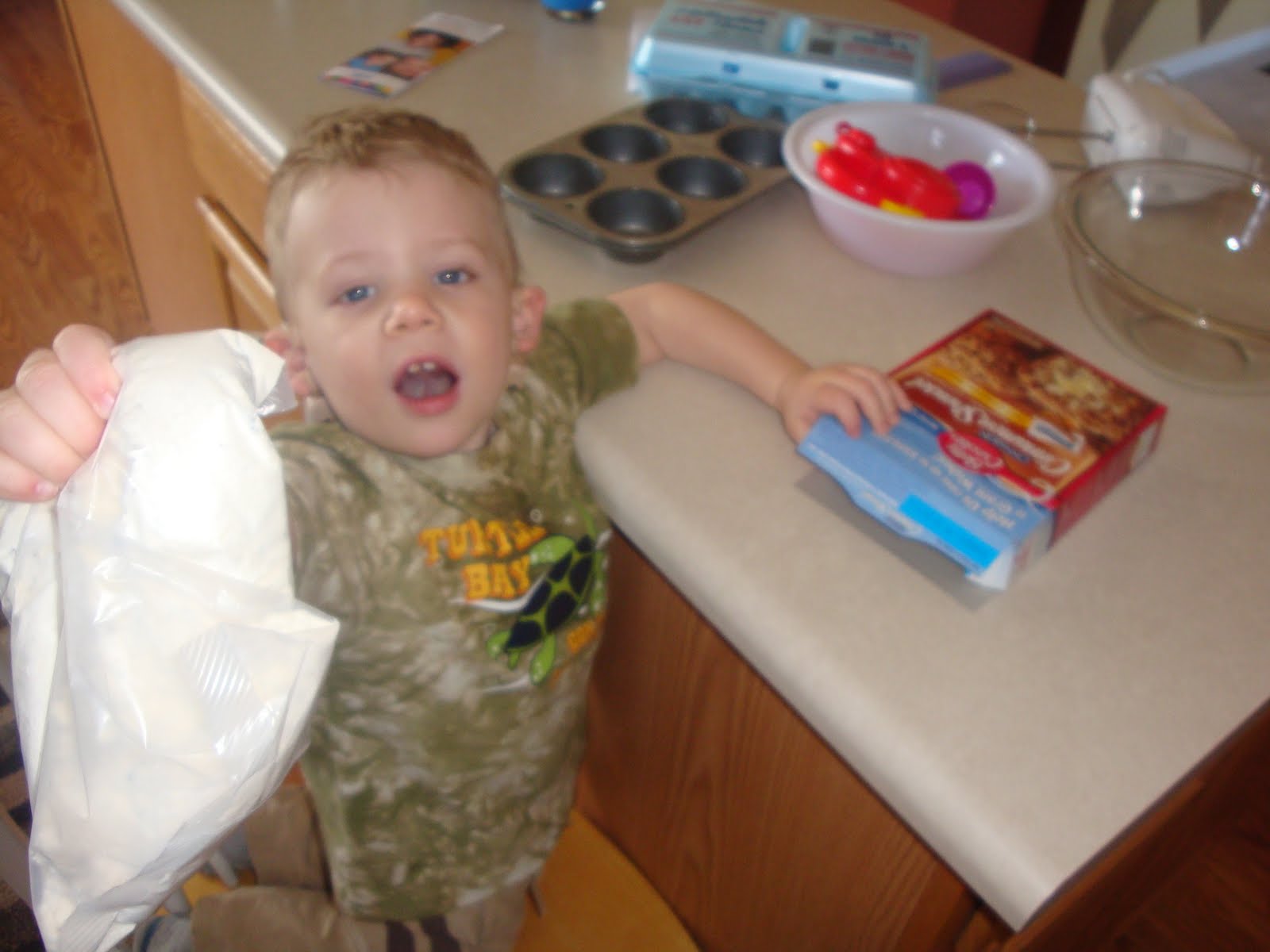
 We measured ...
 and he poured ...


 Aiden got to SCOOP and DUMP, make HILLS then pretend to drive the trucks UP and DOWN the hill, make SNOWBALLS, play find the (insert object), BURY, DIG, and "ooooo, the snow is so COLD, brrrr", FILL the cup up until it's FULL then PAT-PAT-PAT the snow down, and even make a mini SNOWMAN ... all from the kitchen sink.


 Both of these activities also worked on Aiden's sensory integration (SI) goals, such as being able touch and feel different textures but even more so, being able to sustain attention to one activity for more than 5 minutes (which we're working very hard on)! It is very important that he feels a sense of accomplishment to help him attain this goal.

